How Long to Rest Steak After Cooking
Why resting matters and the exact timing for every thickness
- [1]Rest steaks under 1.5 inches thick for 5 minutes and thick-cut steaks (1.5 inches or more) for 10 minutes.
- [2]During resting, internal temperature rises 5-10°F from carryover cooking -- account for this by pulling the steak early.
- [3]Resting allows muscle fibers to relax and reabsorb expelled juices, reducing moisture loss when sliced by up to 30%.
- [4]Rest on a warm cutting board or plate, not a cold surface that would accelerate cooling and reduce the carryover effect.
Rest steak for 5 minutes for standard cuts under 1.5 inches thick, and 10 minutes for thick-cut steaks over 1.5 inches. Resting is not optional -- it is a critical step that allows juice redistribution and carryover cooking to finish producing a perfectly done steak.
Resting Time by Steak Thickness
| Steak Thickness | Resting Time | Carryover Rise | Pull Temp for Medium-Rare |
|---|---|---|---|
| 3/4 inch (thin) | 3-4 minutes | 3-5°F | 128°F |
| 1 inch (standard) | 5 minutes | 5-7°F | 126°F |
| 1.5 inches (thick) | 7-8 minutes | 7-10°F | 123°F |
| 2 inches (extra thick) | 10 minutes | 8-12°F | 120°F |
| Whole roast | 15-20 minutes | 10-15°F | 115°F |
Why Resting Works: The Science
When steak cooks, the intense heat causes muscle fibers to contract and squeeze their water toward the center of the cut. At the moment you remove a steak from the pan, the moisture distribution is uneven -- the outer layers are depleted while the center is pressurized with hot liquid.
During resting, two things happen:
- Muscle fibers relax. As the temperature equalizes, the contracted proteins partially relax and reabsorb some of the expelled liquid. Studies show that a rested steak loses approximately 10% of its moisture when sliced, compared to 30% for an unrested steak.
- Temperature equalizes. The hot exterior conducts heat inward while the cooler center absorbs it. This carryover cooking continues raising the internal temperature by 5-10°F, which is why you must pull the steak before it reaches your target doneness.
How to Rest Properly
- Surface: Place on a warm cutting board or a plate at room temperature. Avoid cold surfaces like granite countertops or refrigerator-cold plates.
- Tent with foil? Optional. A loose foil tent slows cooling slightly but is not required for standard steaks. Skip it for thin cuts (under 1 inch) to preserve the seared crust.
- Do not cover tightly. Wrapping the steak in foil traps steam, which softens the hard-seared crust you worked to build.
- Slice after, never during. Cutting into the steak "to check" during the rest releases the juices you are trying to retain.
The Resting Myth: Does the Steak Get Cold?
A properly seared steak holds its heat well during a 5-10 minute rest. The interior temperature actually continues rising for the first few minutes. By the time you slice and serve, the steak is still well above serving temperature. If you are concerned, warm your serving plates in the oven at 200°F for a few minutes.
Technical FAQ
Q: Does resting steak actually make a difference?
Yes, measurably so. Food science tests consistently show that a rested steak retains 10-15% more of its internal moisture compared to one sliced immediately. The difference is visible on the cutting board -- a rested steak produces a small pool of juice, while an unrested steak floods the plate.
Q: Can you rest steak too long?
Yes. After 15-20 minutes (for a standard 1-inch steak), the steak cools below optimal serving temperature and the crust loses its crispness. If you need to hold steaks for a longer period, place them on a wire rack in a 170°F oven, but this will continue cooking them slightly.
Q: Should I tent steak with foil while resting?
For thick-cut steaks (1.5 inches or more) resting 10+ minutes, a loose foil tent helps retain warmth. For standard steaks resting only 5 minutes, skip the foil -- it traps steam that softens the seared crust. Never wrap tightly.
Tested Application Recipes
ZERO FLUFF // DIRECT EXECUTION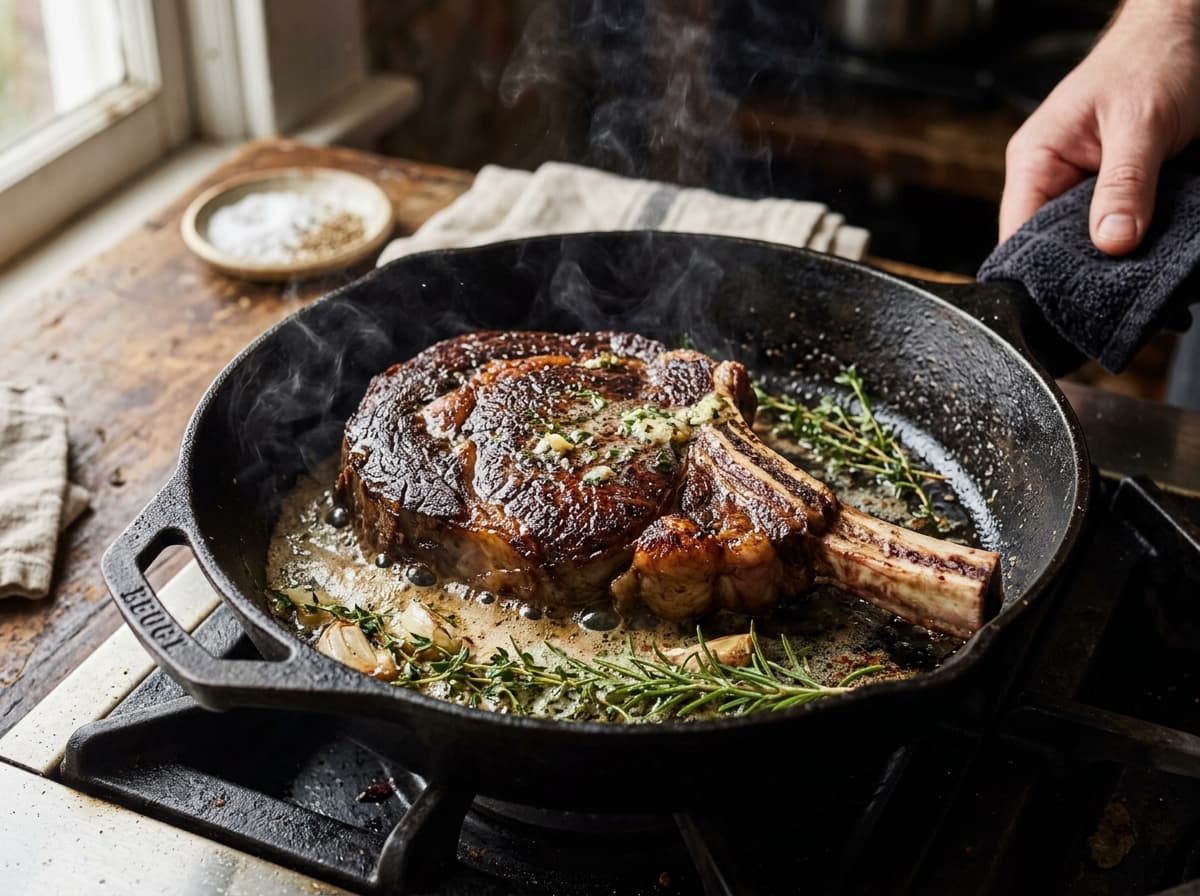
Cast Iron Butter-Basted Ribeye Steak
Restaurant-quality steakhouse sear with garlic herb butter pan basting in 8 minutes.